
"Clinton’s Ditch": The Erie Canal at 200


Two hundred years ago, the Erie Canal was completed. It was a project so ambitious that many thought it foolhardy: building an massive artificial waterway some 363 miles across New York State that would connect the Hudson River at Albany and Lake Erie at Buffalo. The concept of the canal first emerged before the American Revolution, finally coming into focus when New York Governor DeWitt Clinton (1769–1828) started pushing for its construction.

On paper, the plan to carve through virgin forests and mountainous terrain with nothing but manpower, horsepower, and rudimentary tools seemed wildly unrealistic. Many feared the cost of the project would bankrupt New York State. Clinton's critics derisively called the canal “Clinton’s Ditch." Yet Clinton and his supporters knew that if the canal could be completed, it would link the Atlantic Ocean to the Great Lakes, and open the vast interior of North America to new possiblities for trade and settlement like never before.

Construction officially began on July 4, 1817, in Rome, New York. The workforce faced grueling conditions. Swarms of mosquitoes, unpredictable weather, and the constant threat of accidents plagued the project. Nevertheless, progress was steady, and after eight years of relentless work, the Erie Canal was ready to open.
On October 26, 1825, Clinton boarded the packet boat Seneca Chief in Buffalo, beginning a historic voyage to New York City. Along the way, crowds gathered on the canal’s banks to cheer and watched as Governor Clinton poured a keg of Lake Erie water into the Hudson River, a symbolic “Wedding of the Waters” of the Great Lakes and the Atlantic Ocean.

The Erie Canal revolutionized transportation and trade. Before its completion, shipping goods from Buffalo to New York City was expensive and could take weeks. After the canal opened, the journey could be made in just a few days, and shipping costs plummeted. Farmers in the Midwest could send their crops to eastern markets more quickly and cheaply than ever, while manufactured goods and supplies flowed westward with equal efficiency. The Erie Canal transformed New York City into the nation’s busiest port and established it as America’s commercial capital.

An unexpected link between the Erie Canal and Southampton can be found in a series of commemorative medals created to celebrate the completion of the Erie Canal in 1826. Presented to dignitaries and political leaders, the medals celebrated the canal’s engineering achievement. Designed by Archibald Robertson and engraved by Charles Cushing Wright, they feature Pan and Poseidon embracing, celebrating the union of the abundant land with the sea. What makes them especially noteworthy is the involvement of Southampton’s Maltby Pelletreau (1791-1846), grandson of Elias Pelletreau (1726-1810). Maltby’s partnership, Pelletreau, Bennett & Cooke, was engaged to strike the medals in gold, silver and white metal. Only fifty-one gold medals struck and were presented to prominent dignitaries including General Lafayette and three surviving signers of Declaration of Independence. Several hundred white metal medals were distributed to other guests.

The presentation cases for these medals were designed and created by renowned cabinet maker Duncan Phyfe. They were made from wood shipped via the Seneca Chief, physically connecting the canal’s history into the medals themselves.
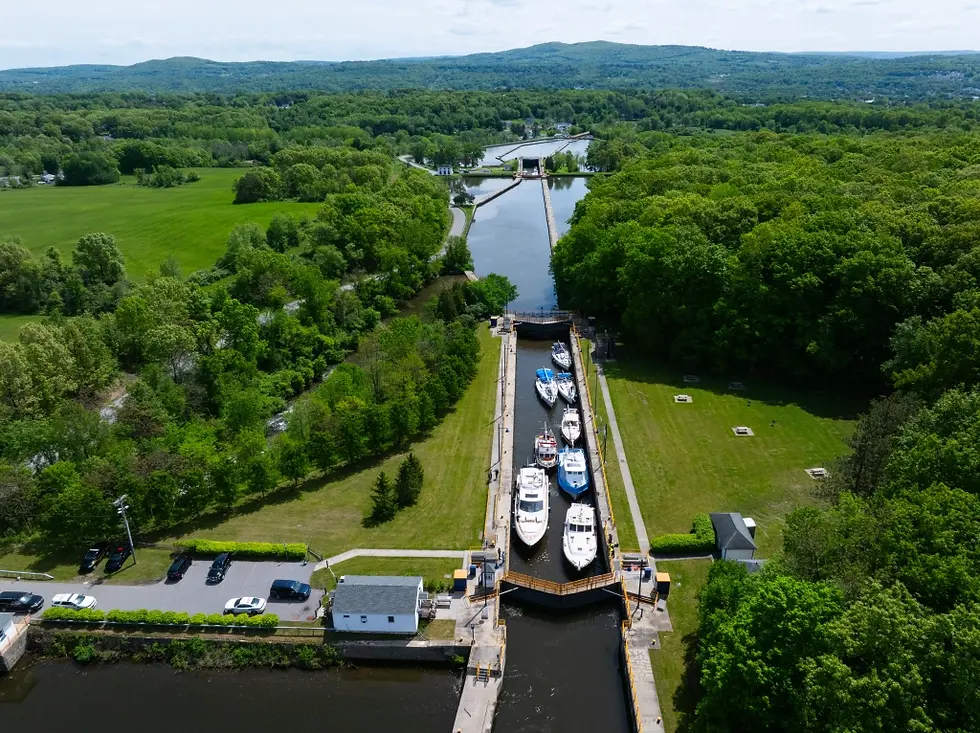
Two centuries on, the Erie Canal stands as more than a marvel of 19th-century engineering—it’s a symbol of bold vision, public investment, and the belief that infrastructure can unite a nation. Its story is a reminder that transformative change often begins with ideas dismissed as impossible, and that when determination meets innovation, even the wildest dreams can carve a lasting path through history—sometimes literally.
The U.S. Congress recognized the Erie Canal's significance to our nation by establishing the Erie Canalway National Heritage Corridor in 2000. The entire Corridor spans 524 miles across upstate New York and includes the Erie, Cayuga-Seneca, Oswego, and Champlain Canals as well as their historic alignments. The Corridor encompasses 4,834 square miles in 23 counties and is home to 3.2 million people!
Watch Floating Ideas: How the Erie Canal Helped Shape America to explore the spread of ideas and culture along the Erie Canal, produced by WCNY Public Media for the Erie Canalway National Heritage Corridor with funding support from the National Park Foundation, the National Park Service, and the New York State Canal Corporation.


