
"The whites of their eyes!"


The Battle of Bunker Hill (also known as the Battle of Breed's Hill), on June 17, 1775 was a bloody repulse to the vaunted British army. It was the latest in a string of miscalculations made by the British government, ultimately leading to the American Declaration of Independence on July 4, 1776.
British Parliment's attempts to tax the American colonies increased resentment throughout the colonies and spurred protests like the Boston Tea Party. Great Britain's response to the Boston Tea Party on the night of December 16, 1773, was swift. British Parliment enacted a series of harsh laws, known as the Coercive Acts (or Intolerable Acts), designed to punish the Massachusetts colony and deter further rebellion.
American merchants in London, including Southampton's own Stephen Sayre, took action. They petitioned Parliament and King George III in opposition to these acts. Their petitions, however, were ignored. Armed conflict soon broke out at Lexington and Concord in April 1775, demonstrating colonial resolve to resist Great Britain. Ongoing acts of rebellion in the colonies further angered Parliament and the King.
In London, Stephen Sayre became more criticaI of the British government, while continuing to advocate for a peaceful resolution. However, the British officials grew increasingly suspicious of vocal Americans speaking out in the heart of London. In October 1775, Sayre was accused of plotting to kidnap King George III. He was arrested for treason and imprisoned in the notorious Tower of London. Although the charges were quickly dismissed, the incident signaled that support for American independence would not be tolerated by the Crown.

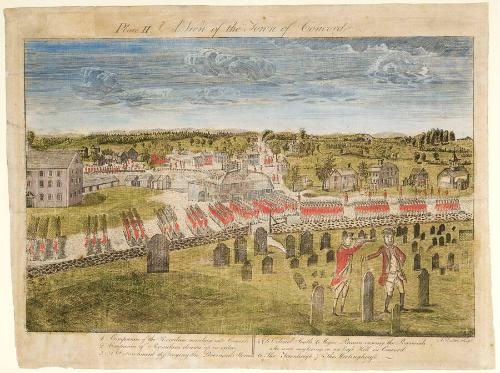
Meanwhile, after the fighting at Lexington and Concord in April, a large number of militiamen gathered around Boston to confront the British Army. Mostly untrained amateurs, the militiamen deeply troubled the British commander in Boston, General Thomas Gage, and he requested reinforcements. These reinforcements arrived throughout May 1775 until they reached a strength of about 6,000 men. Joining these new troops were three generals who would later play a significant role in the future war, Generals William Howe, John Burgoyne, and Henry Clinton.
On the night of June 16, the Patriot militiamen fortified a position on Breed’s Hill on the Charlestown peninsula, threatening to bombard the British in Boston. At dawn on June 17 General Gage recognized the threat and prepared his troops to drive the colonial militiamen from their new position. General Burgoyne was convinced that the "untrained rabble" would be no match for the "trained troops" of the British army. By 2 p.m., General Howe (the senior British officer) had landed his assault force on the Charlestown peninsula and at 3 p.m. the attack began.
As Howe’s troops climbed Breed’s Hill in perfect battle formation, Massachusetts Militia Colonel William Prescott reportedly ordered his men not to waste their ammunition, exclaiming "don’t fire until you see the whites of their eyes!”


The British troops advanced under the heat of the afternoon sun, overheating in their wool uniforms. The colonists withheld their fire until the regulars were close to their line. The British suffered heavy casualties. Two times the British attacked and twice they were repulsed. A third attempt, a bayonet charge at 5 p.m., finally forced the colonists to retreat.
The British had taken the ground but at a great cost, suffering 1,054 casualties, including 226 dead. One of the British casualties was Major John Pitcairn, an officer popular with British and American leaders and who had helped lead the raid on Lexington and Concord. Pitcairn’s son in law, Captain Charles Cochrane, a veteran 4th “Kings Own” Regiment of Foot, was also stationed in Boston. Although he was not part of the assault force on June 17, the death of Pitcairn deeply saddened the young Captain. Cochrane would be later known for his harsh rule as a Loylist infantry commander in occupied Bridgehampton, New York.
The casualty count alarmed British military leaders and probably influenced General Howe to be more cautious during the Battle of Brooklyn one year later. Fierce resistance by the colonists also hardened King George’s resolve to subdue rebellion and may have contributed to his rejection of the Continental Congress' Olive Branch Petition, the last substantive political attempt at reconciliation.

Although the “untrained rabble” had been forced to retreat, the fight also hardened colonial resistance. More militiamen arrived around Boston. General George Washington arrived at Cambridge in July 1775, to take command of the newly formed Continental Army. His successful fortification of Dorchester Heights forced the British troops to evacuate Boston on March 17, 1776, setting the stage for the Battle of Brooklyn in August 1776.
The Southampton History Museum is commemorating the 250th anniversary of the Declaration of Independence with an exclusive new exhibition, Stephen Sayre's American Revolution, along with special blog posts, lectures, gallery talks, and more!


